






Have you ever wondered why you suddenly become super productive the night before an exam or a big deadline?
You might have had two months of study holidays, but you could never focus on your studies. Your mind was distracted. However, on the night before the exam, your mind is so focused and absorbed in the task at hand that you forget your surroundings. There is no distraction whatsoever, and the only aim is to study the entire syllabus somehow.
And you are successful too in studying a lot. Your mind behaves like a big black hole, which sucks whatever information is needed for the next day’s examination.
I am sure on that particular night, you might have taken a vow that you will study well for your next exam, which is about a week later. But history repeats itself, and you are able to give your 100% only the night before the next exam.
Why does this happen?
How are we able to study more during the previous night before an exam?
It is not because of some sort of magic or an increase in adrenaline, but it is the ‘Temporal Motivation Theory’ at work.
What Is Temporal Motivation Theory?
Temporal Motivation Theory is a scientific explanation of why we delay tasks and what actually triggers us to take action. It is well explained by the below-given formula :
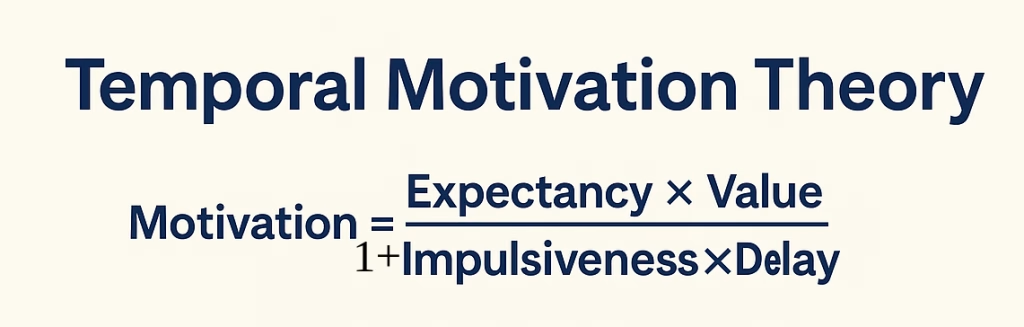
In this formula:
- Expectancy = Your belief that you can succeed (When you believe that you will do well, your motivation goes up)
- Value = The reward (If your goal really matters to you, motivation rises.)
- Impulsiveness = Your tendency to get distracted (the more impulsive you are, the harder it is to stay on task.)
- Delay = How far away the reward is (if the reward feels too far away, motivation drops)
Why Does Time Change Everything?
From the formula above, you see that the ‘delay’ is given in the denominator. If the time available is more, then the reward is far away, and if the time available is less, the reward is too close. Thus, if the time available is more, your motivation is reduced, and if the time is less, the motivation to do a task is increased.
Let’s say you have a final exam in 30 days. You know it is important (it has high value), and you think you can do well (high expectancy), but if the exam is one month away, then that delay kills your motivation.
Thus, you involve yourself in all merrymaking activities. But when the exam is in the next two days, suddenly you are as if in a beast mode. You start quickly going through the notes, start revision, prepare last-minute mind maps, and get into whole-hearted preparation.
Why? Because as the delay shrinks, motivation skyrockets.
How to use temporal motivation theory to increase your focus?
1. Make the Goal Feel Closer
Your exam may be far away, say after 30 days. But, you should break down the syllabus and set yourself mini-deadlines.
You should fix a target to complete a few chapters each day and stick to the target.
2. Increase the Value
Remind yourself often about why this goal matters. For example, the forthcoming exam will decide my future, so it is very important (visualize your dream goal often).
3. Boost Expectancy
Believe in your talent and ability. Say to yourself often, “I finished one topic already; I can do this too!”
4. Control Impulsiveness
- Turn off distractions.
- Use timers.
- Reward yourself after every task.
Conclusion
If your mind was able to focus very well on the previous night of the exam, it can do so on other days too. In order to attain the same amount of focus, you only need to know the reason why your mind was able to focus on that particular Night. The reason is best explained by the Temporal Motivation theory.
Once you understand the theory well, you can put it into use to increase your focus any time you want and thus achieve your dream goal.
References: