



The shocking incident often quoted by Visualization experts
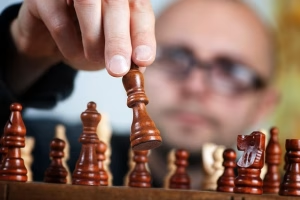
The entire world was shocked when the news spread that world chess champion Garry Kasparov was defeated by an ex-prisoner in a match conducted in Israel. The ex-prisoner was Natan Sharansky, who was a former Soviet dissident.
The friendly chess match occurred in the year 1996, when Kasparov was 33 years old and was the world champion, and Natan Sharansky by then had become a minister in the Israeli government.
This incident is often referred to by motivational speakers and writers whenever the importance of the ‘mental rehearsal technique’, a highly effective ‘visualization method’ to manifest success, is explained. The popular version is that Natan Sharansky, while in jail, used to practice playing chess games in his mind to overcome the torture and pain. This mental rehearsal helped him master chess moves, that finally helped him beat the world chess champion.
Is it a true incident?
I read about this incident in a motivational article that focussed on the power of visualization. I was skeptical when I read this story for the first time and decided to verify the facts. Upon searching on the internet, I found that the incident was true. I found a few news articles about the incident and you can find the link to those articles at the end of this post.
Who was Natan Sharansky?
Born in 1948 in Donetsk (now in Ukraine), Natan Sharansky was a computer scientist and a passionate advocate for human rights. During his childhood days and teenage, he used to play a lot of chess. Sharansky even won a championship in his native city of Donetsk at the age of 15. His dream was to become a chess champion one day.
Natan Sharansky’s arrest
Natan Sharansky was arrested in 1977 by Soviet authorities for his activism and his outspoken criticism of the regime. He was accused of espionage and treason. Sharansky was sentenced to 13 years in a Soviet labor camp.
Natan Sharansky’s life in prison was marked by extreme isolation, physical abuse, and psychological torture. He spent the majority of his time in solitary confinement. During his nine years of imprisonment, Sharansky endured brutal conditions like cramped and filthy cells, insufficient food, and also very harsh forced labor.
How he spent his time in prison without becoming mad
In order to mentally cope with the dire circumstances that he was in, Sharansky developed a ‘mental rehearsal technique’, using his imagination to visualize positive experiences. He started playing his childhood passion, the chess game, in his mind. Deprived of a chess board in jail, Sharansky started playing games in his mind. Thus he developed tremendous abilities to anticipate chess moves. This technique allowed him to preserve his sanity and sense of self, preventing the prison conditions from completely overwhelming him. Despite the physical and psychological torment, Sharansky never gave in and stood his ground.
The mental rehearsal technique
Mental rehearsal is a technique of mentally practicing an activity without actually performing it. It is also known as mental imagery. It involves the imagined mental practice of performing an actual task. It is the practice of vividly imagining a scenario or action in your mind. It is like “training” your brain by rehearsing in your head the actions or outcomes you desire—whether that’s performing well in a presentation, winning a race, or overcoming a difficult situation.
In Sharansky’s case, mental rehearsal became a way for him to escape the physical constraints of his environment.
Why it works: The Science Behind Mental Rehearsal
The mental rehearsal technique works because the brain doesn’t distinguish between real and imagined experiences in some cases. When you visualize an event, especially in minute detail, your brain activates similar neural pathways as if the event were actually happening. For example, a person rehearsing playing football mentally may strengthen the motor skills associated with that action without physically playing the game.
Research has shown that mental rehearsal can lead to actual performance improvements in various fields, including education sports, music, etc. It enhances focus, reduces anxiety, and also increases self-confidence. The mental rehearsal technique is especially effective in managing stress and overcoming adversity.
Research studies
In a study conducted by Dr. Blaslotto in 1996 at the University of Chicago, the students were divided into three different groups and were given the task of undertaking free throws in basketball.
The first (control) group did not practice shooting any free throws for thirty days. The second group practiced shooting free throws every day, and the third group did only mental rehearsals by visualizing shooting free throws.
After 30 days, the participants in all three groups were tested. The result was:-
1. The group that did not practice at all – No significant improvement.
2. The group that practiced by shooting free throws daily – performance improved by 24%,
3. The group that only visualized shooting free throws – performance improved by 23%.
It was observed that the measurable improvement in the group that purely did mental rehearsal only was almost equal to that of the group that had physically practiced.
Also, a notable study by Dr. Richard Suinn in the 1970s found that the athletes who used only mental rehearsal were able to improve their performance significantly in comparison to those who practiced physically.
Researchers have also found that mental rehearsal activates the same parts of the brain that are involved in physical performance, i.e. the motor cortex areas,
Famous personalities who used this technique
Muhammad Ali, the world-famous boxer, often visualized his success before stepping into the ring, and he credited it with part of his mental rehearsal. His famous quote is, ” I am the greatest, I said that even before I knew I was. I would visualize success, and I would rehearse in my mind how I would win, the moves I would make.”
Similarly, Tiger Woods, the world-famous golf player emphasizes that visualizing his shots allowed him to control his performance on the course, even before taking the physical action. He once said, “I’ve always had a clear image of what I wanted to do and I would rehearse those images in my mind. I do it every day. The more you do it, the more comfortable you are.”
Hollywood comedian Jim Carrey, often talks about the visualization techniques he uses to manifest success while speaking on stage. His famous lines are: “I visualized having a check for 10 million dollars for acting services rendered. I would visualize it all the time. I would visualize myself being successful.”
Another great person who put into use the mental rehearsal technique is Serena Williams, a former tennis champion. She once said “I always visualize the match before I play it. I see myself hitting perfect shots, and I feel it. It really helps me prepare for what’s to come.”
How to put mental rehearsal technique into practice
- Have a clear intention and a goal. For example, achieving the top position in the coming competitive exam
- Start with Relaxation: Find a quiet place where you can relax and clear your mind. Deep breathing or meditation can help prepare your mind for focused visualization.
- Start visualizing and performing the task: Use all your senses to make the visualization as vivid and realistic as possible. For example, you should see yourself performing the task, hear your voice, feel your breath, smell the environment, touch the objects, etc in your imagination. It should be like a mental movie.
- Feel the emotions you would experience in that moment. This enhances the realism of the visualization.
- Focus on your Success: Visualize a positive outcome. See yourself overcoming challenges or succeeding in your goal. Rehearse this scenario regularly.
- Practice It Daily: Just like physical practice, mental rehearsal requires repetition. The more you practice, the more natural and powerful it becomes.
- Stay Positive and Patient: It may take time for the benefits to manifest, so practice patience and maintain a positive attitude.
Personal experience
During my state civil service exam preparatory phase, I put into use the mental rehearsal technique effectively. I used to mentally rehearse about how I would write my exam confidently. For example, I used to imagine traveling to the exam center, sitting on the allotted seat, receiving question paper, confidently going through the paper, taking three deep breaths before start answering, drawing the margins in the answer sheets, start writing the long answer questions that give the maximum marks, drawing pictures or maps/ tables, finally concluding each answer with an attractive conclusion. I would parallelly imagine how quiet the exam room would be, the movement of invigilators, the sound from the fan and bells, feeling my breath, etc… I would also imagine a few difficult questions that had been asked and how intelligently I give the answers with whatever little knowledge I have about that topic. At last, I would imagine submitting the answer sheet satisfied and walking out of the room.
I used to practice this not only while comfortable in my room but also during uncomfortable times like occasions when I was struck somewhere where I was not in a position to do studies. For example, while traveling or waiting at some office etc.
The mental practice helped me a lot in my State Civil Service written exam, as the number of questions asked that year was far more than expected. Instead of being perplexed and confused, I just took three deep breaths and started writing. The practice of mental rehearsal is certainly a contributing factor towards achieving my dream goal.
Conclusion
Natan Sharansky’s life story proved that the mental rehearsal technique is very effective in giving positive results in any field of action. Mental rehearsal is grounded in psychological and neuroscientific principles. It is now recognized as a valuable tool in many aspects of life, from sports to business to personal challenges. Hence, if you are an aspirant who aims to achieve unstoppable success, then you should practice the ‘mental rehearsal’ technique daily.
References:
- https://en.wikipedia.org/wiki/Natan_Sharansky
- https://www.nytimes.com/1996/10/16/world/kasparov-beaten-in-israel-by-russians.html
- https://www.researchgate.net/publication/228118007_Does_Mental_Practice_Enhance_Performance
- https://pmc.ncbi.nlm.nih.gov/articles/PMC7709374/
You may also be interested in the following posts
- https://theunstoppablemind.com/atomic-habits-1-improvement-rule-is-that-sufficient-to-achieve-massive-success/
- https://theunstoppablemind.com/a-grateful-reflection-how-raj-bapnas-mind-power-study-techniques-changed-my-life/
- https://theunstoppablemind.com/a-psychological-strategy-to-overcome-exam-anxiety-mental-rehearsal/
- https://theunstoppablemind.com/pomodoro-time-management-method-the-secret-success-strategy-used-by-toppers/