



Let me share my experience about the ‘Don’t Quit’ poem. I was in Jodhpur, Rajasthan, and passing through very bad times. The success that I longed for had not yet reached me. All my classmates had achieved very good positions in life, and here I was living a defeated life. I was unable to find any way to achieve my dream goal. It was as if the path was closed. I feared that a strong urge to resign to fate and carry on a normal, unworthy life would overpower me, and thus I would quit everything. There was no ray of hope. But, thankfully, one thing that I never stopped was going in search of motivational and Self-help books.
The books were a great source of solace for me. I would underline all the important points or portions that motivated me.
In one of the books, I stumbled upon the poem ‘Don’t Quit”.
I cannot explain to you how this poem gave me a new ray of hope during those bad times. I don’t know how many times I had read that poem that day, again and again. Every line motivated me and gave me new hope.
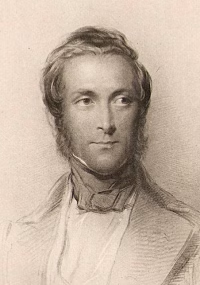
I wanted to express my immense gratitude to the poet, but If I remember correctly, the name was not there. Later I learned that Edgar A. Guest wrote it. But the poem is also attributed to John Greenleaf Whittier.
Whoever was the poet, I express my sincere gratitude, as the poem gave a straightforward and uplifting message of hope.
Here is the entire poem for you:
Don’t Quit
When things go wrong, as they sometimes will,
when the road you’re trudging seems all uphill,
when the funds are low and the debts are high,
and you want to smile but you have to sigh,
when care is pressing you down a bit – rest if you must, but don’t you quit.
Life is queer with its twists and turns.
As everyone of us sometimes learns.
And many a fellow turns about when he might have won had he stuck it out.
Don’t give up though the pace seems slow – you may succeed with another blow.
Often the goal is nearer than it seems to a faint and faltering man;
Often the struggler has given up when he might have captured the victor’s cup;
and he learned too late when the night came down,
how close he was to the golden crown.
Success is failure turned inside out – the silver tint of the clouds of doubt,
and when you never can tell how close you are,
it may be near when it seems afar;
so stick to the fight when you’re hardest hit – it’s when things seem worst, you must not quit.
What a classic piece of motivational poetry!
I used to open the book and read this poem whenever I felt dejected and depressed. I used to read it slowly, line by line. The lines gave me a new ray of hope. The lines of the poem are like drops of water that a thirsty traveler finds to drink in the hot desert.
Why Don’t Quit Poem Motivates Us? Research studies:
We all know that words have immense power. When well presented in an emotional way by any orator or a poet the words give immense motivation and strength to the individuals to move towards their dream goals. Various research studies have proved this point.
Neuroimaging and psychophysiology studies show that reciting poetry elicits strong emotional responses, akin to music, which support engagement and motivation (please see reference 3 below)
Research in positive psychology (“broaden-and-build” theory) suggests that positive emotions, such as those sparked by uplifting poems, can broaden thinking and build psychological resources. Also it enhances motivation and resilience over time( Please see reference 4 below)
FAQ Section
Q: Who is the actual author of “Don’t Quit”?
A: “Don’t Quit” is commonly credited to Edgar Albert Guest (1881–1959), though some sources attribute it to John Greenleaf Whittier too.
Q: What is the main message of the poem?
A: Don’t Quit poem encourages perseverance against adversity—reminding readers that success often comes just after moments of greatest struggle.
Q: How can I use this poem in daily life?
A: Take a print and paste it on the wall. Try reading the Don’t Quit poem at least once weekly. Narrate it in your talks or motivational presentations.
Q: Who was Edgar A. Guest?
Edgar Albert Guest was a British-born American poet who became known as the People’s Poet as his poems often had an inspirational and optimistic view of everyday life.
Q. Who was John Greenleaf Whittier?
John Greenleaf Whittier was an American Quaker poet and advocate of the abolition of slavery in the United States.
Q. Has motivational poetry been shown to increase motivation?”
Research studies show that motivational poetry induces positive emotions, which can increase psychological resources, and helps you stay motivated. Incorporating poems into teaching improves literacy, motivation, and self-confidence. Also, there are studies that prove that poems help patient cope better emotionally
References
- https://en.wikipedia.org/wiki/Edgar_A._Guest
- https://en.wikipedia.org/wiki/John_Greenleaf_Whittier
- https://pmc.ncbi.nlm.nih.gov/articles/PMC5597896
- https://en.wikipedia.org/wiki/Broaden-and-build
Other useful posts