

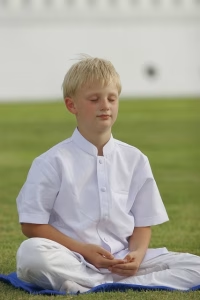

What happens when we are in extremely stressful situations?
Our minds race, and a river of thoughts carries us away. We feel helpless and unable to escape from the flow. This happens especially when we are overwhelmed by circumstances. We are not in the present moment and our minds are full of worries about future happenings.
You might have often noticed upon reflection once the situation is over, that many of the worries were unwarranted. Nothing happened as bad as you feared. However, during the happening of that unpleasant situation, you were in complete distress.
What if we have a technique wherein we are easily able to ground ourselves or come to the present moment, in the shortest possible time, so that our mind can bring about a positive solution to the existing problem whenever we face it?
There is one such wonderful technique. It is called the ‘5-4-3-2-1 Grounding Technique’.
It is so simple, yet, very effective to rein our racing mind.
5-4-3-2-1 Grounding Technique
The 5-4-3-2-1 Grounding Technique is a mindfulness exercise. It is a sensory-based exercise, designed to help individuals regain control during overwhelming moments. It reduces anxiety and panic attacks too. The main advantage is that the ‘5-4-3-2-1 Grounding Technique’ helps a person to quickly anchor himself to the present moment.
A person is able to anchor his awareness to the five senses — sight, touch, sound, smell, and taste. The ‘5-4-3-2-1 Grounding Technique’ uses a countdown pattern through the senses.
Why ‘5-4-3-2-1 Grounding Technique’ Works: The Science
It is a well-known fact that during moments of stress, the amygdala region in our brain triggers an adrenaline surge that elevates our heart rate, breathing, and also negative thoughts. In order to calm down the Parasympathetic Nervous System should be activated.
‘5-4-3-2-1 Grounding Technique’ works by activating our Parasympathetic Nervous System, which calms the body’s fight-or-flight response.
Neuroscience-based studies have shown that mindfulness-based grounding reduces cortisol (the stress hormone), lowers heart rate variability, and improves emotional regulation in humans.
How to Practice the 5-4-3-2-1 Grounding Technique?
You can practice this 5-4-3-2-1 Grounding Technique anytime and anywhere.
Step-by-Step Instructions
Step 1: Take a deep breath. Pause. Begin to notice your surroundings.
Step 2: Acknowledge FIVE things you can SEE.
Examples: Book, Laptop, Water bottle, Table, Pen
Step 3: Acknowledge FOUR things you can TOUCH or FEEL
Examples: The ground beneath your feet, A pillow, a T-shirt, a Soft Cushion
Step 4 – Acknowledge THREE things you can HEAR.
Examples: Birds chirping, Horns, Water from the tap
Step 5 – Acknowledge TWO things you can SMELL.
Examples: Spray, Food
Step 6 – Acknowledge ONE thing you can TASTE.
Examples: A toffee
Step 7 – End by taking a slow, deep breath.
Now you can feel that your body and mind become calmer and more grounded.
Tips for Effective Practice of 5-4-3-2-1 Grounding Technique
- Practice daily, not just during panic.
- If needed customize the order or senses. You can go for 5 sounds, 4 things to see, etc.
- Use it before every stressful situation like exams, interviews, public speaking, etc.
- Write it down as a journal entry.
Conclusion
The 5-4-3-2-1 technique is not only a coping tool, but also a daily anchor in our fast-paced world. Whether you’re a student overwhelmed by exams or someone battling daily stress, grounding yourself in the present moment can reset your nervous system, clear your mind, and restore your emotional balance.
Hence in order to get wonderful success, you should practise being in the present moment and perform with a calm mind.
References
Bouchard, S., Dumoulin, S., Robillard, G., et al. (2017). Grounding techniques in the treatment of posttraumatic stress disorder: A randomized controlled trial. Journal of Anxiety Disorders.
Kabat-Zinn, J. (2003). Mindfulness-based interventions in context: Past, present, and future. Clinical Psychology: Science and Practice.
Harvard Health Publishing (2021). Relaxation Techniques: Breath control helps quell errant stress response.