



Neuroscience secrets to motivate yourself
Stop blaming yourself for lacking motivation to study for your dream goal (UPSC civil service or state PCS, etc). If you feel like not studying, it is not just because of your laziness. It is all because of how your brain is wired to avoid hard efforts.
Don’t worry. You can train your brain and divert it towards your studies. In order to do this, first, you have to understand what happens at your brain level when you are less motivated.
Please read the complete article below. It contains:
- Why do we feel unmotivated to study, though our goal is important?
- What are the ten major reasons and the brain regions involved in a lack of motivation?
- How to overcome the lack of motivation and motivate yourself to study?
1. Why do we feel unmotivated to study, though our goal is important?
It is a common experience among all aspirants preparing for the UPSC or state civil service exams that they often lack proper motivation for studying. They may open their books and stare at the pages, but are unable to focus and study. The time just moves on, and the entire day will be wasted without any fruitful studies. You feel as if nothing moves.
Have you ever wondered why you experience this lack of motivation? Why are you unable to study, though you understand that success in the forthcoming UPSC or State Civil Service exam will change your future forever? Is it that you are lazy?
As someone who has walked this path myself (during the state civil services exam), I know what it feels like to want to study but not feel like studying. It is very frustrating and confusing. At times, it feels like a battle against your mind.
The real reason you often lack motivation to study is not because you’re lazy or undisciplined, but, it is because your brain is naturally wired to avoid hard efforts and chase instant rewards, not long-term goals.
This is true with respect to UPSC or State civil service aspirants, as the path feels long. The lack of motivation is not a moral failure. It is a biological and psychological puzzle that can be overcome only when you fully understand how your brain works.
In this article, we will go deep into the neuroscience of motivation, why it disappears, and, most importantly, how to rebuild it.
2. What are the ten major reasons and the brain regions involved in a lack of motivation?
Though the reason for losing motivation during the preparatory stage differs from person to person, below are the major reasons found among the aspirants:-
The most important reason: Lack of a Strong Purpose or Reason
The biggest and foremost reason for the lack of motivation for UPSC exam aspirants is that they don’t have a strong purpose or a ‘why’ to achieve the goal. This lack of purpose kills motivation silently. When you don’t have a clear reason why you’re doing something, even simple tasks feel heavy and meaningless.
Purpose acts like fuel for the mind as it gives direction, energy, and a sense of meaning to every effort. As Friedrich Nietzsche said,” He who has a ‘why’ to live for can bear almost any how.’ A strong purpose ignites passion inside you. When you know your why, the how becomes easier.
Now let us understand the brain region involved in respect of the lack of purpose.
Brain Region Involved: Ventromedial Prefrontal Cortex (vmPFC)
This area is responsible for assigning value to long-term goals and connecting present actions to future rewards. When you lack a strong “why” behind your efforts, this region doesn’t activate effectively, leading to disengagement and apathy.
Solution:
- Ask yourself: “What will this exam help me to become?
- What kind of life do I want?”
- Read or watch success stories of people who once stood where you are.
- Make the subject meaningful—relate it to your goals, your future, and your family.
- Keep a vision board of your dream career, lifestyle, or college.
Ten More Major Reasons
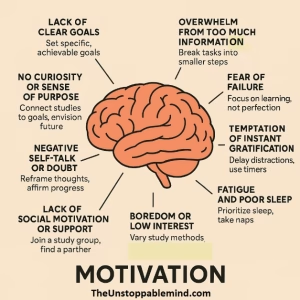
1. Lack of Clear Goals
Brain Region Involved: Prefrontal Cortex (PFC)
When you have no target before you or when you lack clear goals, the brain’s executive system reduces effort. The dorsolateral prefrontal cortex (DLPFC) of our brain helps us in setting long-term goals, planning, and organizing.
When your goals are vague or missing, this area has less engagement. Thus, it leads to aimless behavior and procrastination.
The result is that you lack motivation to study.
2. Low Dopamine Levels
Brain Region Involved: Ventral Tegmental Area (VTA), Nucleus Accumbens
Dopamine is a very powerful brain chemical often called the “motivation molecule.” It drives our desire to achieve goals and seek rewards. Dopamine is produced in areas like the ventral tegmental area (VTA) and acts on regions such as the nucleus accumbens. It creates feelings of pleasure.
When dopamine levels are balanced, we feel enthusiastic, focused, and driven to take action. However, a lack of dopamine can lead to feelings of boredom, fatigue, low interest, and even depression.
When our dopamine levels are low then the tasks feel harder, rewards seem less exciting, and the brain struggles to generate the push needed to begin or persist.
This is especially true with respect to UPSC exam aspirants who have a long, effortful goal.
In short, without dopamine, our motivation stalls.
3. Absence of Rewards or Feedback
Brain Region Involved: Nucleus Accumbens (Reward Center), Ventral Tegmental Area (VTA)
When a person wants to excel in tough exams like UPSC civil services or State PCS, he is involved in long years of study. It is a common experience that during this phase, you don’t feel any progress. Once you feel that there is no progress, your reward circuitry goes quiet.
The neurochemical Dopamine is released only when we anticipate or receive rewards. Hence, if there is no anticipation of rewards, there is no dopamine, resultantly there is no motivation either.
4. Overwhelm or Too Much Information
Brain Region Involved: Amygdala, Anterior Cingulate Cortex (ACC)
UPSC exam aspirants have to study and store a lot of information in order to reach their goals. This information overload can hijack emotional centers, thus shutting down the efforts.
The amygdala detects emotional threats. Too much input triggers stress, causing fear or avoidance. The Anterior Cingulate Cortex (ACC) detects errors, flags the overload as “too risky” to proceed.
Thus, you lack the motivation.
5. Fear of Failure
Brain Region Involved: Amygdala, Orbitofrontal Cortex (OFC)
Fear of failure causes the brain to freeze or escape, rather than fight. Once the fear of failure comes, the amygdala overreacts to threats like failing exams. The Orbitofrontal Cortex (OFC) tries to weigh consequences but may amplify negative outcomes. This loop can paralyze decision-making.
Thus, you are unable to move forward and study.
6. Instant Gratification Temptation
Brain Region Involved: Striatum, Ventromedial Prefrontal Cortex (vmPFC)
Your brain is wired to choose what feels good now; that is, we tend to seek instant gratification. The striatum region is the one that pushes you toward pleasure, and the Ventromedial Prefrontal Cortex (vmPFC) evaluates “now vs. later” benefits.
If short-term rewards (like YouTube or Instagram) seem better, the brain chooses them instead of long-term rewards.
7. Poor Sleep and Fatigue
Brain Region Involved: Prefrontal Cortex, Thalamus, Hypothalamus
As UPSC exam aspirants often put in long hours of study, it makes the brain tired. A tired brain doesn’t care about goals—it just wants rest.
Fatigue impairs the Prefrontal Cortex, reducing focus, willpower, and memory. The thalamus region reduces attention, and the hypothalamus reduces energy regulation due to a lack of sleep. Hence, the lack of sleep is one of the major reasons for the lack of motivation among UPSC aspirants.
8. Lack of Social Motivation or Support
Brain Region Involved: Medial Prefrontal Cortex (mPFC), Oxytocin Pathways
Humans are social learners. Our brain is wired to care more when it feels connected. The Medial Prefrontal Cortex (mPFC) processes social feedback and belonging.
If you feel isolated, your motivation drops. Oxytocin also influences trust and bonding. Thus lack of support is another reason for our low motivation.
9. Negative Self-Talk and Low Self-Efficacy
Brain Region Involved: Default Mode Network (DMN), Anterior Insula
Negative self-talk is a major reason for the lack of motivation among UPSC exam aspirants. When your inner critic dominates, your brain sees the effort as pointless.
The Default Mode Network (DMN) handles our inner dialogue, like rumination, self-doubt, regrets, etc. The anterior insula processes “gut feelings,” especially around self-worth.
Negative loops here sap our motivation to study.
10. Lack of Novelty or Curiosity
Brain Region Involved: Hippocampus, Substantia Nigra
Without curiosity or novelty, your brain switches to autopilot and disengages. The hippocampus thrives on learning new things. The substantia nigra releases dopamine when there’s novelty.
Boring routines dull both regions, thus resulting in a lack of motivation to study.
3. How to overcome the lack of motivation and motivate yourself to study?
1. Lack of Clear Goals
When UPSC exam aspirants don’t know exactly what they are aiming for, it’s hard to stay motivated. Vague intentions like I will study tomorrow don’t activate urgency or focus.
Solution:
- Set crystal-clear goals for the week.
- Break them down into daily tasks.
- Use ‘to-do’ lists, planners, or apps to track your progress.
- Start every day with a 2-minute planning ritual: “Today I will complete…”
- Celebrate each completed task (even small wins matter).
2. Low Dopamine Levels
When dopamine levels are very low, everything feels dull, boring, and effortful. You may feel unmotivated. But the good news is, dopamine can be naturally boosted through simple daily habits.
Solutions:
1. Set Small, Achievable Goals:
Break your big tasks into tiny, winnable steps. Every time you complete one task, your brain gets a small dopamine hit, building motivation.
2. Celebrate Progress:
Don’t wait for big achievements. Celebrate small victories like finishing a topic or a lesson, waking up on time, or maintaining a study streak, etc. This triggers dopamine release.
3. Exercise Regularly:
Physical movement like brisk walking, stretching, or cardio exercises boosts dopamine and other feel-good chemicals. Practice at least for 15 minutes a day. It makes a difference.
4. Get Sunlight and Sleep Well:
Natural sunlight in the morning helps regulate your dopamine rhythm. Good sleep is also essential for improving dopamine levels.
5. Eat Dopamine-Friendly Foods:
You should include protein-rich foods like eggs, fish, paneer, nuts, and dark chocolate. They contain tyrosine, the building block of dopamine.
6. Visualize Rewards Often:
You should think about the long-term outcome, for example, becoming a civil servant, doctor, or engineer. Just visualizing success can trigger motivational chemicals like dopamine, which in turn will boost dopamine.
3. No Rewards or Feedback
Without any feeling of progress or reward, studying feels like a dead-end chore. We all need feedback to stay motivated. When you feel progress, you naturally want to keep going.
Solution:
- Share your progress with someone who can cheer you on, for example, a mentor, parent, or friend.
- Give yourself small rewards after focused study sessions. It can be a small treat or 10 minutes of music.
- Use apps that track your streaks or give visual progress.
4. Overwhelm from Too Much Information
Facing an ocean of material can create anxiety. It’s hard to start when everything feels like “too much.”
Solution:
- Begin your session with the simplest or most interesting task.
- Break study material into chunks: one chapter, one topic, and one formula.
- Use the Pomodoro technique. Study for 25 minutes, then take a 5-minute break, and then continue.
- Declutter your desk and your digital environment.
5. Fear of Failure
The fear of not performing well can paralyze you before you even begin. It creates avoidance, excuses, and low confidence. Fear fades when you take action, even imperfectly.
Solution:
- Visualize completing your goal and how that will feel.
- Shift your focus from “What if I fail?” to “What will I learn?”
- Take small risks daily, like solving difficult questions without fearing mistakes.
- Speak to yourself like a coach, not a critic: “It’s okay to try and fail. I’ll get better.”
6. Temptation of Instant Gratification
Most of the UPSC aspirants tend to reach for their Phones, play games, eat snacks, or watch movies rather than sitting with a textbook. They are tempted by Instant Gratification.
Please remember that discipline becomes easier when you manage your temptation.
Solution:
- Delay your distractions. You can tell yourself, “I will check Instagram after this 30-minute study session.”
- Pair the study with something mildly enjoyable, like background instrumental music.
- Turn off notifications or use “focus” mode on your phone.
- Create a reward ritual: “When I finish this chapter, I’ll enjoy a guilt-free break.”
7. Fatigue and Poor Sleep
When you are mentally or physically drained, even very simple tasks feel heavy.
Energy fuels motivation. A well-rested brain is sharper, quicker, and more motivated.
Solution:
- Prioritize sleep. Aim for at least 7–8 hours of deep sleep each night.
- Keep a consistent sleep-wake schedule (even on weekends).
- Take short naps (15–20 mins) if you’re drained in the afternoon.
- Stay hydrated and avoid heavy or sugary foods while studying.
8 . Lack of Social Motivation or Support
Studying alone all the time can make some UPSC aspirants feel isolated or invisible. It becomes easier to quit when no one knows you’re trying.
Solution:
- Celebrate your progress with people who genuinely care about you.
- Join a study group or find an accountability partner.
- Share your weekly goals with a friend or mentor.
- Participate in online forums or Telegram groups where others are preparing too.
9. Negative Self-Talk or Doubt
Negative self-talk is a big enemy of success. Telling yourself “I’m not good enough” or “I can’t do this” drains your energy before you start.
Confidence grows from how you speak to yourself daily.
Solution:
- Practice daily affirmations rooted in truth: “I am capable. I am learning.”
- Catch and reframe the negative thoughts: Replace the self-talk “I always fail” with something positive like “I am still improving.”
- Keep a daily “progress log.”
- Revisit your past achievements.
- Remind yourself: “I’ve overcome tough things before.”
10. Lack of Novelty or Curiosity
When studying feels dull, your brain resists engagement. Repetition and monotony can kill your drive. Curiosity fuels focus. Variety keeps you going.
Solution:
- Switch up your methods. For example, you can watch YouTube videos on the subject or listen to podcasts, etc.
- Rotate between subjects to avoid mental fatigue.
- Gamify your study
- Link what you’re studying to real-world examples
Conclusion
Lack of motivation is not just because you are lazy or undisciplined. It is also not because of a lack of willpower. But it is due to the fact that your brain has not been wired towards success.
The brain is wired towards instant gratification and avoiding effort. If you understand the working of the brain’s natural systems, you can apply certain techniques and get yourself motivated.
By applying neuroscience principles like goal clarity, reward triggers, and habit loops, UPSC exam aspirants can build a study routine that feels less like a struggle and more like a purposeful mission.
Consistency becomes easier when the brain is trained correctly. Start small, stay steady, and let science support your success
Other useful posts :