



A team of researchers from the Universities of Geneva (UNIGE), Harvard, and McGill used artificial intelligence (AI) recently to uncover how a small part of the brain called the Ventral Tegmental Area (VTA) plays an important role in motivation.
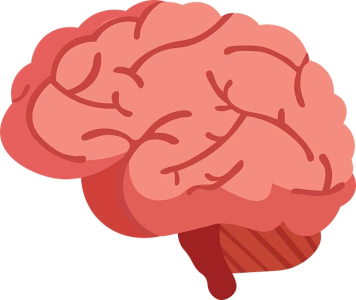
The Ventral Tegmental Area (VTA) is a tiny region deep in the brain that produces dopamine, a chemical responsible for motivation in humans.
For a long time, scientists believed that the Ventral Tegmental Area responded only when we received a reward. But, the University of Geneva website (link given below), recently published the details of the above-mentioned study, as per which, it was found that the Ventral Tegmental Area (VTA) region of the brain encodes not only the anticipated reward but also the precise moment it is expected.
Experiments on animals have shown that when a reward consistently follows a ”light signal’, the VTA eventually releases dopamine not at the moment of the reward, but as soon as the signal appears. This response therefore encodes the prediction of the reward linked to the signal than the reward itself.
These findings are an outcome of a fruitful dialogue between neuroscience and artificial intelligence. A purely mathematical algorithm that incorporates the timing of reward processing and extensive neurophysiological data on VTA activity in animals experiencing rewards was used together to achieve a positive outcome.
Resources:
https://www.unige.ch/medias/en/2025/un-algorithme-revele-comment-se-motive-notre-cerveau