


PLEASE NOTE: This article may be read only by those who seriously suffer from exam anxiety. A small amount of anxiety will usually be there for most of the students, and a small amount of stress is actually good too, as it helps to perform better. But for some, the exam anxiety will be so severe that it hampers their chances of success. This article addresses only those people, and so this article may be skipped by those who don’t feel serious exam anxiety.
This article contains:-
- Exam anxiety
- Mental rehearsal technique
- How does mental rehearsal calm the mind?
- The neuroscience behind Mental rehearsal
- Sportsmen who practised mental rehearsal
- 5-step method to practise mental rehearsal
- Various research on mental rehearsal (for those interested)
Exam anxiety
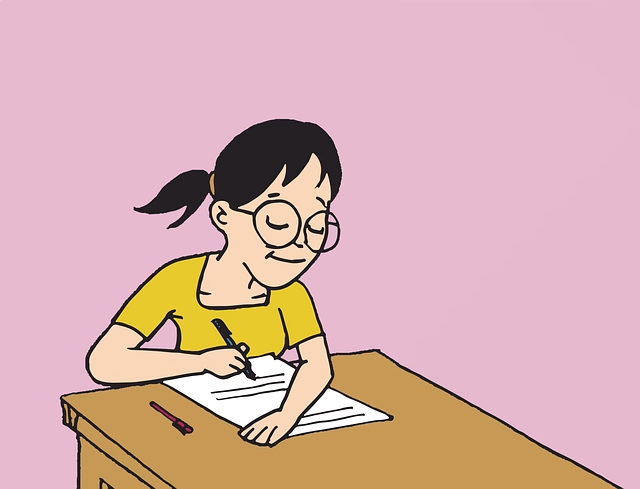
Despite preparing well, revising tirelessly, and solving hundreds of model question papers, some students are affected by severe exam anxiety in the examination hall. Just before the exam, their heart races, their memory feels blank, and their confidence disappears. Some people experience sweaty palms too. Exam anxiety is the worst enemy that spoils a student’s career.
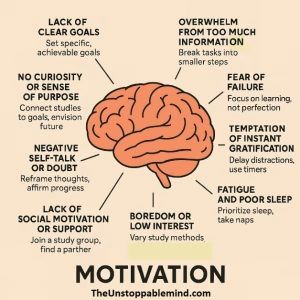
Exam anxiety is a mix of fear of failure, uncertainty about performance, low confidence, overthinking outcomes, and feeling overwhelmed by the stakes. The anxiety increases when one steps into an unfamiliar or high-pressure environment. The brain of the person undergoing exam anxiety perceives the unfamiliar environment as a threat and thus triggers a fight-or-flight response. That is the reason why the person feels a blank mind and sweaty palms, etc.
Mental rehearsal technique
The happy news is that there is a proven psychological strategy to overcome exam anxiety. It is the mental rehearsal technique, which is being practised by world-famous athletes, musicians, politicians, public speakers, etc.
Mental rehearsal is the act wherein you visualize yourself performing a certain task successfully and confidently before you actually do the task. It is different from daydreaming. It is a deliberate act. It is a purposeful visualization of success.
I had practised this technique during my preparation for the state civil service exam. I used to visualise vividly about entering the examination centre, sitting at the allotted place, filling up the forms, getting the question paper, hearing the bell ring, cutting open the question paper, calmly writing the answers, asking for more answer sheets, and finally confidently submitting the answer sheet.
In the same way, for the interview, I visualise going to the interview hall well dressed, entering the hall with a smile, wishing all the interviewers, sitting confidently on the allotted chair, looking confidently into the eyes of the interviewers, answering the questions calmly ( I imagined all sort of questions that they may ask). I also used to visualise the interviewers asking stressful questions and how I give answers calmly.
I used to practise this several times a day.
The result was that when the final exam day came, I felt that it was just another visualization. The situation looked very familiar, and I was at ease. Thus, I could fully focus on giving good answers.
How does mental rehearsal calm the mind?
Our brain does not fully distinguish between real experiences and vividly imagined ones. Hence, when you mentally rehearse exam scenarios, you are actually making them feel familiar to your brain. Once the situation becomes familiar to the brain, there will be no panic trigger.
The neuroscience behind Mental rehearsal
Neuroscience shows that your brain activates the same neural pathways when you visualize an activity as when you actually perform it. Thus, the more you perform mental rehearsal, the more neural pathways are formed, which will help during actual performance.
Sportsmen who practised mental rehearsal
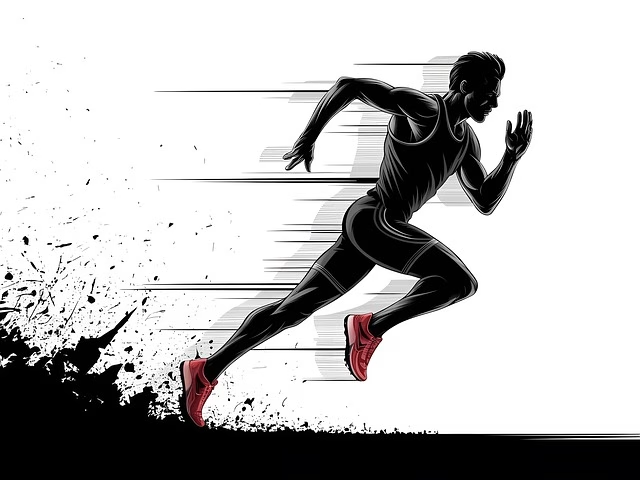
Michael Phelps, the world-famous US swimmer and Olympic medalist, used to practice mental rehearsal daily. He not only visualized every stroke of every race, but also visualized about what all things may go wrong- for e.g. his goggles filling with water. In the 2008 Olympics, during the 200-meter butterfly final, such a situation actually happened. As Phelps had mentally rehearsed all the worst scenarios beforehand, he stayed calm, counted his strokes, and still won the gold medal..
In the same way, Michael Jordan used visualization to mentally rehearse games and all the high-pressure moments. He used to see himself making shots and executing plays flawlessly before stepping onto the court. That was one of the reasons he remained calm and relaxed on the ground while playing.
5-step method to practise mental rehearsal
- Choose the situation – for example, writing the civil services mains essay paper.
- Sit down, close your eyes, and relax. Take a few breaths and calm down.
- Visualise vividly the situation, with minute details. Imagine positive outcomes like calm response, confidently writing exams, etc
- Add emotion -Feel the confidence, the happiness, the relaxed experience, the joy, etc. Engage all senses.
- Repeat daily – five to ten minutes a day
Various research on mental rehearsal (for those interested)
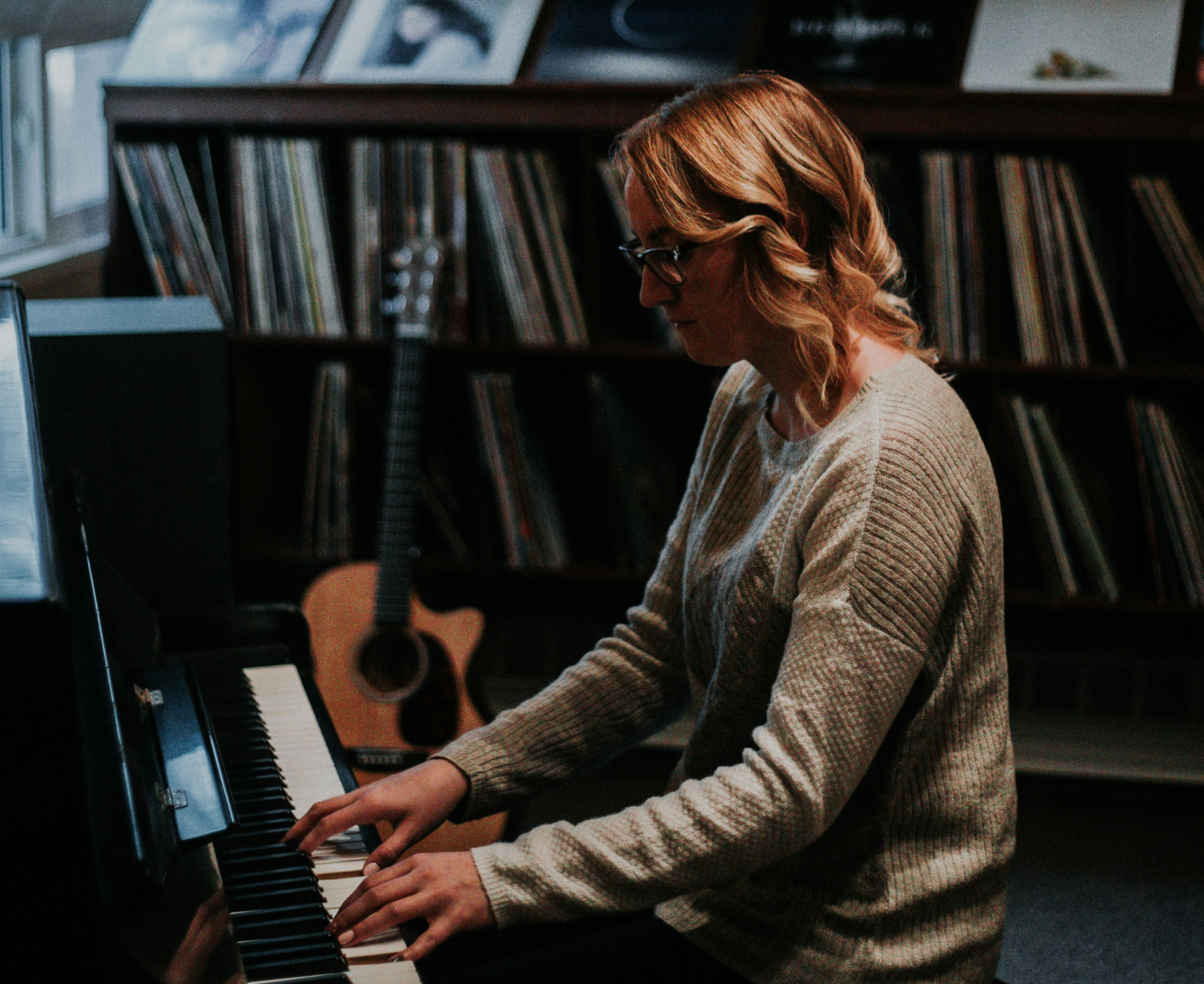
A Harvard study found that visualizing piano practice activated the same motor regions of the brain as the actual piano practice. Thus, it was found that those who mentally rehearsed playing piano showed almost the same improvement as those who physically practiced playing piano. (Pascual-Leone et al., 1995)
Conclusion
Mental rehearsal is the most efficient and science-backed psychological tool that you can use effectively to remove exam anxiety.. Once you put it into practice, passing tough exams will be a cakewalk.
All the best.