




This article contains:-
- What is flow state?
- Who presented the concept of flow state?
- The neuroscience of ‘flow state’
- The relation between flow state and success
- How does flow state occur?
- Learn the secret to enter the flow state whenever you want (while preparing for your dream goals)
What is flow state?
Have you ever noticed that while doing some task, you sometimes were so immersed in the activity that you forgot time, fatigue, and everything else but the activity itself? You might have noticed that you paid no attention to the surroundings or distractions during that period, and you were completely engaged and involved in the task at hand.
The mental state that you were experiencing while doing the activity is what psychologists call a flow state. Flow experiences usually happen when you are doing something that you enjoy a lot and in which you are quite skilled too.
While in a flow state, your attention is fully invested in the task at hand, and you function at your fullest capacity.
Who presented the concept of flow state?
The concept of flow state was popularised by Hungarian-American psychologist Mihály Csíkszentmihályi in his book ‘Beyond Boredom and Anxiety’.The flow state has been described by Csikszentmihályi as the “optimal experience” in that one gets to a level of high gratification from the experience.
According to him,”Flow is being completely involved in an activity for its own sake. The ego falls away. Time flies. Every action, movement, and thought follows inevitably from the previous one, like playing jazz.”
The neuroscience of ‘flow state’
Neuroscientists have found that during a flow state, the brain releases neurotransmitters like dopamine and serotonin. These neurotransmitters enhance focus and motivation, thus contributing to sustained attention and improved performance.
The relation between flow state and success
Flow state contributes to success of a person by optimizing the mental and emotional conditions for peak performance. Flow state research on impact on learning outcomes shows that when students are in a state of flow, they are more likely to experience a heightened sense of focus, concentration, and intrinsic motivation. Thus, it leads to improved learning outcomes.
How does flow state occur?
The phenomenon of flow is well known in the field of performance of artists, athletes, and scientists. However, if the conditions are right, flow state also occurs in everyday life when being involved in more challenging activities, too. It is found that if a task is too easy, it is unlikely that one will experience a flow state, as feelings of boredom and mind‐wandering occur. Also,if the task is too difficult, then also flow state does not occur as one will experience immense stress.
The flow state is characterized by:
- Complete concentration
- Intense focus
- A sense of effortless action
- Distorted sense of time (time seems to fly)
- Heightened sense of control
- Merging of action and awareness.
- Find activity immensely rewarding
- Reduction of self-consciousness (not worrying about what others may think of us)
- Have clear goals (knows what aims to achieve)
- Pleasant and rewarding experience
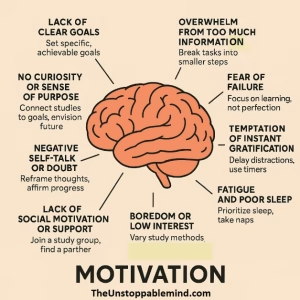
In order to reach the flow state of mind, you should get involved in a task that is interesting and engaging. Also, conditions like an environment without disturbance, zero distractions, setting of certain time blocks for the task, positive mental and physical state etc, are also essential
Learn the secret to enter the flow state whenever you want, while preparing for your big dream goals
Now comes the million-dollar question. How to enter the flow state whenever we want? As you are aware, flow state only occurs when certain conditions are met. For example, the task should not be too difficult or too easy, the task should be enjoyable, etc. Also, you get into the mental state of flow if the task is interesting and engaging.
But for those who are engaged in serious studies to achieve their dream goal, how to satisfy the conditions?
The answer to the above question lies in Mr Mihály Csíkszentmihályi’s own words. According to him, “The more a job inherently resembles a game—with variety, appropriate and flexible challenges, clear goals, and immediate feedback — the more enjoyable it will be regardless of the worker’s level of development.”
Thus, the secret is to make your studies more interesting and engaging through various means. Unfortunately many aspirants, who might have come across the concept of ‘flow state of mind’ are not able to use the psychological tool because they are not aware about this one secret.
You should turn Study into a Game, in order to increase engagement. For example, you can set rewards for consistency (earn a chocolate break after 3 focused study blocks) or try to beat your own previous mock scores, etc.. Thus, you should take more interest in studies and should enjoy them fully.
You can use your right side of the brain for imagination/visualisation of concepts, use memory methods etc. You can also use mind maps for taking notes while study.
I enjoyed my study a lot by creating my own stories while learning a concept. For example, while studying Indian History, I wrote down all the names of kingdoms in chronological order like Magadha, Nanda, Maurya, Sunga and so on. Then I linked those names of the kingdom to the persons who were known to me. After that, I linked them all by creating a story where my friends and relatives were the characters. I often used to visualise this story during my free time. Once this story was ready, whenever I got some new information about any kingdom, I would add that to the already prepared story. Thus, it was fun and engaging.
Also, I used to solve many multiple-choice questions, and whenever I checked the scores, it made me happier, and my motivation level increased.
Other than the one secret mentioned above the following should be done in order to get quickly into the flow state of mind.
- Establish clear goals
- Reduce distraction
- Stop multitasking
- Find your peak performance time
- Create a pre-flow ritual, like a short prayer or meditation
- Seek immediate feedback, like checking your score
- Take breaks
- Focus onthe enjoyment of the task rather than the outcome
- Practise Mindfulness